 Korean life, curious minds & everyday tech
IT · Study ·
How Hangul Works on Your Phone—and What Changes in the Age of AI
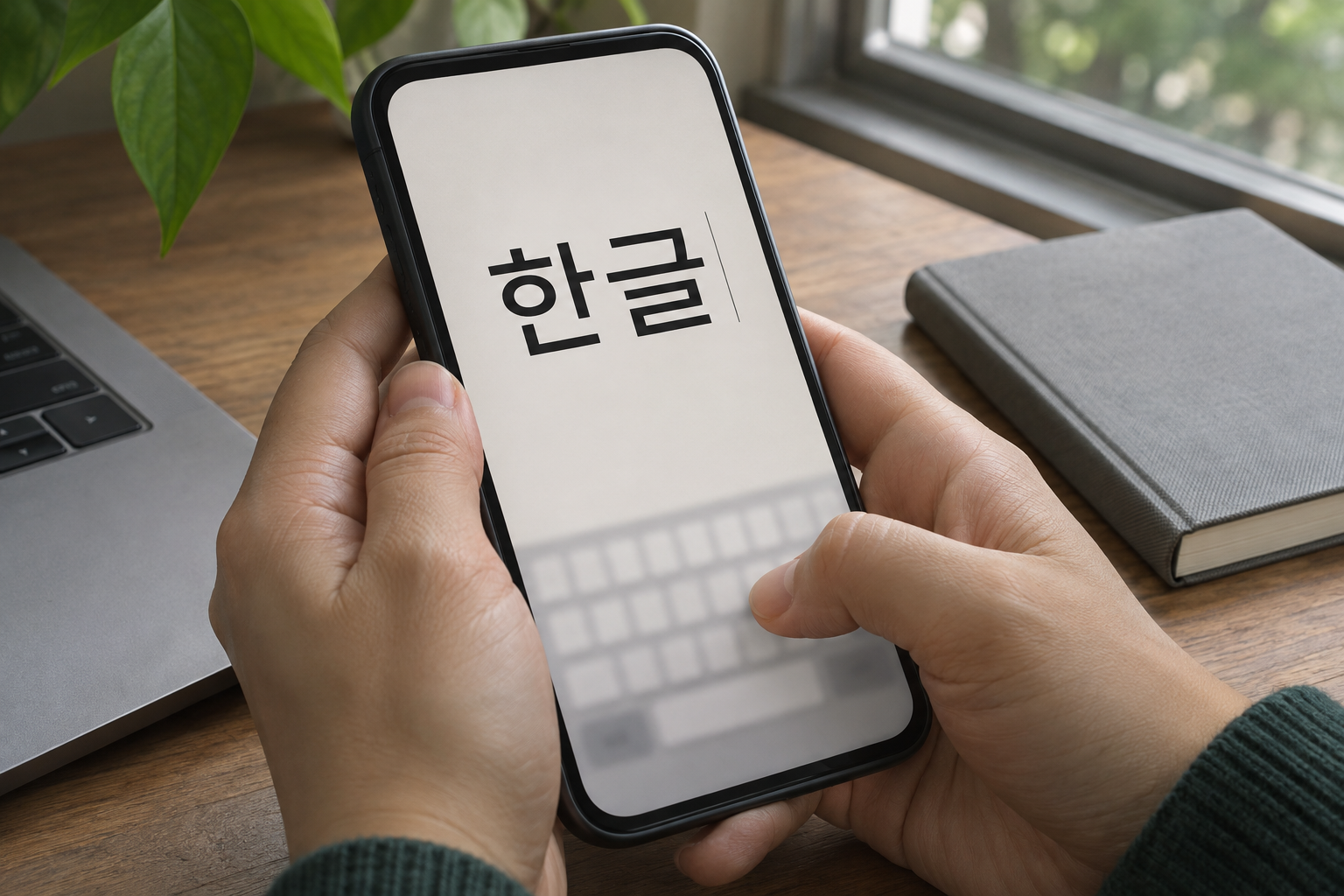
Type a few Korean letters and the screen seems to rearrange them: ㄱ becomes 가, then 간, then 가나. You have not searched through thousands of complete characters. You have entered smaller letters, and an input method has assembled the syllable blocks. That small everyday interaction is a good way to appreciate Hangul—and to understand why typing Korean and teaching AI Korean are different engineering problems.
First, Hangul is a script; Korean is a language
Hangul is the writing system. Korean is the language, with its vocabulary, grammar, speech levels and pronunciation. Learning the letters gives you access to the written language, but does not automatically teach you how to understand a conversation. King Sejong created the alphabet in 1443, and the Hunminjeongeum was promulgated in 1446. Its continuing usefulness is something you can experience directly: the same principle of grouping letters into syllables appears when you type a message centuries later.
National Institute of Korean Language — the creation of Hangul ↗
Watch four letters turn into two blocks
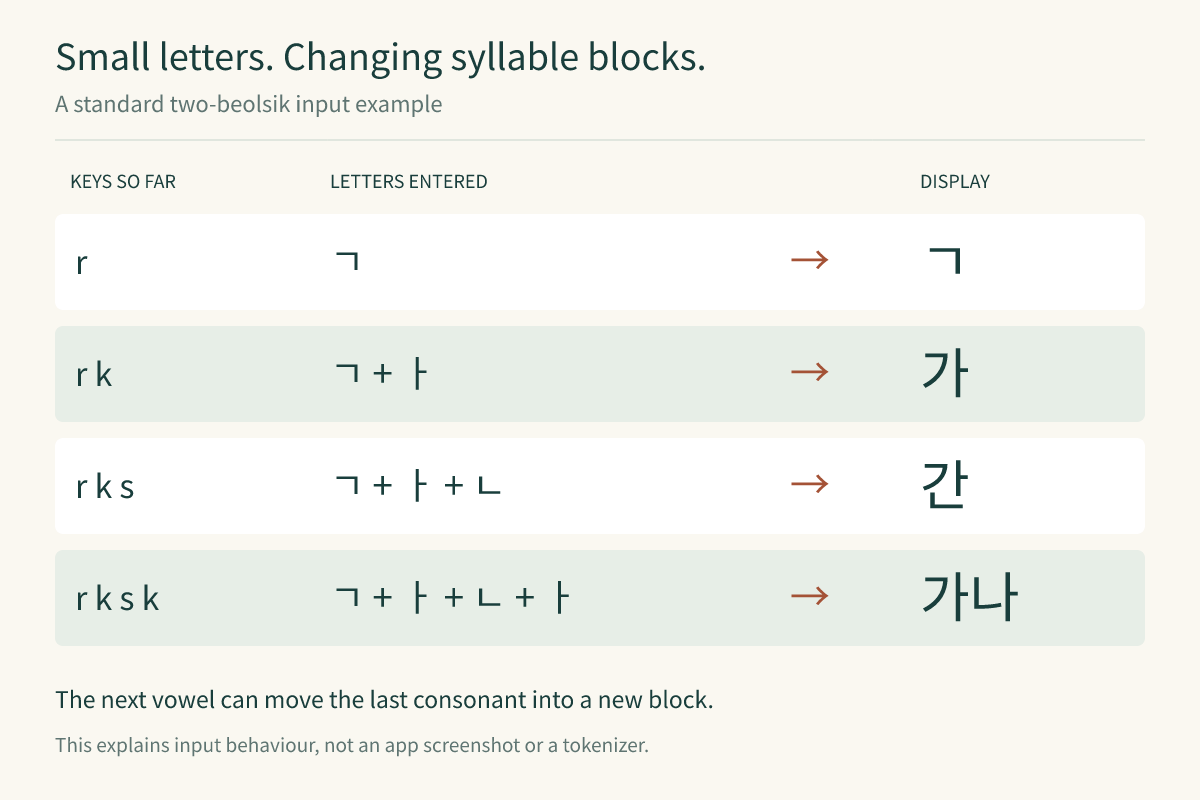
In a standard two-beolsik Korean input method, try entering ㄱ, ㅏ, ㄴ, ㅏ in that order. The display can progress through ㄱ → 가 → 간 → 가나. After the first vowel, ㄱ and ㅏ form 가. Adding ㄴ gives the current block a final consonant, producing 간. When the next vowel arrives, the input method treats ㄴ as the beginning of the next syllable, producing 가나. This is an input-composition example, not a statement that every appearance of 간 should be read as part of 가나. The surrounding text and the next key matter.
Microsoft — Korean IME and syllable composition ↗
The keyboard does not need a key for every syllable
On the common two-beolsik layout, consonants and vowels have separate key positions, with consonants mainly on the left and vowels mainly on the right. The input method editor, or IME, keeps track of the block being composed. On a standard English-labelled keyboard set to this Korean layout, r corresponds to ㄱ, k to ㅏ and s to ㄴ. So rks produces 간 while composing. You are using those physical key positions, not typing the romanization gan. A display that shows rks as Latin letters is still in English input mode; switch the input language or mode first.
Why phone keyboards do not all look the same
A Korean keyboard on a phone can use a QWERTY-style arrangement related to the desktop layout, or a compact system such as Cheonjiin. The smaller layout reuses keys and input actions rather than giving every vowel its own full-size key. The letters and language are the same; the route used to enter them is different. Samsung lists QWERTY, Cheonjiin and other Korean layouts in its keyboard settings. Availability and exact gestures depend on the keyboard app and device version. There is no need to master every layout at once: choose one and stay with it long enough to learn where the letters are.
| Input method | What you do | What to remember |
|---|---|---|
| Two-beolsik / QWERTY-style | Select consonant and vowel keys; the IME builds blocks | Physical r, k, s positions are not romanization |
| Compact phone layout, such as Cheonjiin | Combine a smaller set of keys and actions | Key combinations depend on the selected keyboard |
| Voice input | Speak and review the recognized text | Recognition mistakes can change words or endings |
Samsung Electronics Service — Korean keyboard options ↗
Try this without changing your whole phone to Korean
Open a notes app, add Korean to your keyboard languages, and choose a layout. Google’s Gboard instructions let you add a keyboard language independently of the phone’s display language. On Windows, install Korean input and select the Korean IME; its A/가 indicator distinguishes Latin from Hangul input mode. Start with the four-letter example above. Then try 한글: ㅎ + ㅏ + ㄴ makes 한, and ㄱ + ㅡ + ㄹ makes 글. On standard two-beolsik key positions, gksrmf gives 한글. If a keyboard offers a different arrangement, follow its visible labels rather than these QWERTY key positions.
Google Gboard Help — add a language and choose a layout ↗
Why Backspace can feel surprising
While the IME is still composing an active syllable, Backspace may remove part of the composition rather than erase a whole completed word. After text is committed, moved into another app or selected, deletion behaviour can differ. Keyboard settings, the app and cursor position all matter. If a block changes unexpectedly, slow down and watch the active composition before deciding that the character is broken. Try the example in a blank note rather than in a live message or an important form.
What the computer stores is another layer
Unicode directly encodes 11,172 modern Hangul syllables. The count comes from 19 possible initial consonants × 21 vowels × 28 final positions, where one final position means no final consonant. It is a count of encoded modern syllable combinations, not a count of Korean words or the number of keys you must learn. Unicode can also represent a syllable using conjoining jamo. Precomposed and canonically decomposed forms can look alike while containing different code-point sequences. Normalization helps software handle equivalent representations consistently; the standalone letter shapes in our typing diagram are a visual explanation, not an instruction to concatenate compatibility jamo and expect Unicode normalization to build a syllable.
Unicode — Korean jamo and syllable encoding ↗
In AI, a syllable block is not automatically one token
Many language models first divide text into tokens. Depending on the tokenizer, a token may cover a word piece, a character or other units; there is no universal rule that one visible Hangul block equals one token. Korean endings and particles create many related word forms, so splitting the text is a design choice that researchers study. A 2026 EACL paper tested morphology-aware Korean tokenization and reported improvements and fewer tokens in its experimental setting. A separate 2025 machine-translation paper studied jamo-based tokenization. Those results describe particular systems and tests, not proof that every Korean model should use the same method or that Korean always costs less than another language.
Lee et al., EACL 2026 — Morpheme Matters: Korean tokenization research ↗
The clever alphabet does not make AI automatically fluent
Hangul’s regular composition makes a compact writing system possible, but Korean ability in AI also depends on training data, objectives, model design and evaluation. An AI tool can produce neatly formed syllables while choosing an unsuitable honorific, inventing a fact or translating a sentence too literally. A keyboard solves “which letters did you enter, and how should they be arranged?” A language model faces the different task of predicting useful language in context. Neither a smooth voice nor a well-formed word is a guarantee of understanding. For an important name, date, instruction or quotation, verify the result against the original source.
A useful way to learn with AI
Ask a tool for one short everyday sentence, its meaning and an explanation of when it sounds natural. Compare it with a reliable learning reference, then type the Korean yourself instead of only pasting the answer. This separates three skills: recognizing the letters, producing the text and understanding the sentence. If a system gives odd sounds or broken characters, investigate the input and encoding before treating the output as Korean. Clear instructions can help a model, but they do not remove the need to check its answer.
A thank-you to King Sejong
세종대왕님, 한글을 만들어 주셔서 감사합니다. means “King Sejong, thank you for creating Hangul.” It is a respectful commemorative sentence, not something you need to say at every keyboard. 세종대왕 (Sejong Daewang) is King Sejong the Great, and -님 adds respect. 만들어 주셔서 (mandeureo jusyeoseo) acknowledges someone respectfully for doing something; 감사합니다 (gamsahamnida) is a polite “thank you.” The sentence celebrates a writing system whose usefulness you can test with your own hands.
One line of Korean: thank you for Hangul
- Today’s Korean
세종대왕님, 한글을 만들어 주셔서 감사합니다.
Sejong Daewangnim, Hangeureul mandeureo jusyeoseo gamsahamnida.
King Sejong, thank you for creating Hangul.
Listen, then try saying the sentence. This is synthetic Korean speech.
Sources & technical reading
Microsoft — Korean IME and syllable composition ↗
National Institute of Korean Language — the creation of Hangul ↗
Samsung Electronics Service — Korean keyboard options ↗
Google Gboard Help — add a language and choose a layout ↗
Unicode — Korean jamo and syllable encoding ↗
Unicode Standard — Hangul composition and normalization ↗
Lee et al., EACL 2026 — Morpheme Matters: Korean tokenization research ↗
Lee et al., LoResMT 2025 — jamo-level Korean machine translation ↗
Independent educational information. Details and circumstances can change. Verify important information using the linked sources. See About for our editorial approach and important limitations.
Keep reading
Meet BLACKPINK: Four Members, One Song to Start With, and a Little Korean
How Much Cash Do You Need in Korea? Cards, Cash and Payment Apps Explained
Korean Age vs International Age: Why K-pop Fans Still Talk About Birth Years