 Korean life, curious minds & everyday tech
Korea · Travel ·
How Much Cash Do You Need in Korea? Cards, Cash and Payment Apps Explained
If Japan taught you to keep cash ready, and China taught you to set up Alipay before leaving home, what should you prepare for Korea? For a typical city trip, start with a physical international bank card, a second way to pay, and a modest reserve of Korean won. Cards are widely accepted, but cash still solves some everyday problems—and a cashless checkout can make the opposite true.
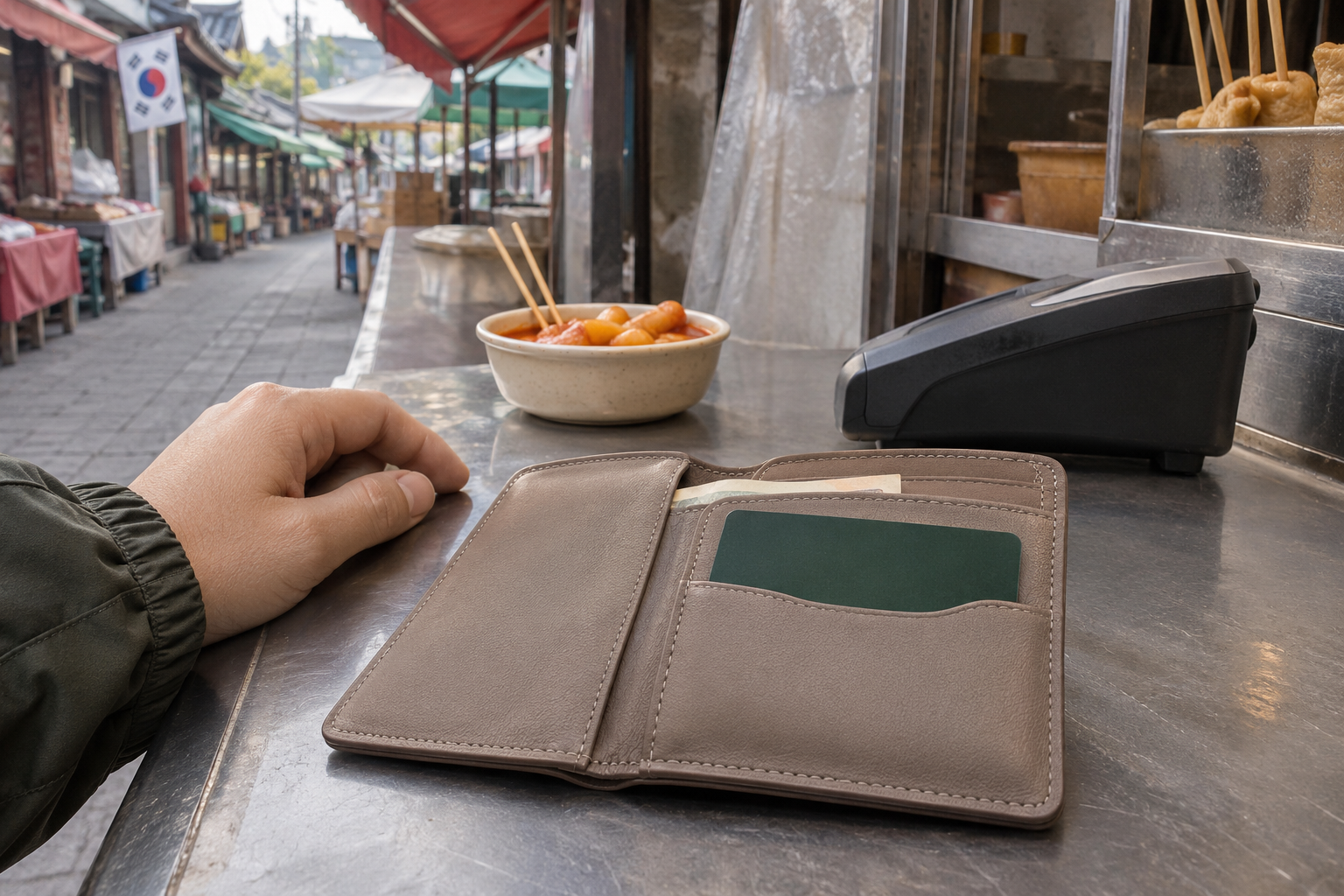
The practical answer: card first, cash in reserve
For a three- or four-day city visit, our starting suggestion is ₩50,000–₩100,000 in cash per adult, assuming accommodation and most meals or shopping are paid by card. This is an editorial planning range, not an official minimum or a survey of average spending. You may use less, or need more for market shopping, remote stops or a failed card. It is a starting reserve to review during the trip, not an amount you must spend each day. A card plus cash gives you more options than either one alone.
VISITKOREA — currency, cards and authorized exchange ↗
Japan, China and Korea: the habit to prepare
These are useful preparation habits, not rules that every shop follows. Japan has growing cashless acceptance, while JNTO still advises carrying cash. In China, setting up Alipay or Weixin Pay and testing verification can spare you friction; official guidance also describes bank-card and cash options. In Korea, a physical international card is a practical starting point for ordinary purchases. Do not assume your preferred phone wallet, a bank card and a transit card are interchangeable.
| Destination | What to prepare first | The trap to avoid |
|---|---|---|
| Japan | Cards plus readily available yen cash; check small or rural businesses | Assuming every shop or ticket machine accepts your card |
| China | Set up and verify a supported mobile wallet before travel; keep cash/card backup | Waiting until checkout to discover an account or linked-card problem |
| Korea | A physical overseas card, some won cash, and a plan for local transport | Expecting a foreign bank card to tap through every transit gate, or relying on phone-only payment |
A cash amount you can actually plan around
Treat the figures below as adjustable examples for card-led travel, with major bookings paid separately. Couples and families can share some backup money, but each traveler should still have a way to pay if separated. If you plan to spend heavily in markets or somewhere you have confirmed is cash-only, add that spending explicitly. Cash is a reserve, not a complete Korea travel budget.
| Trip pattern | Cash to start with | Assumptions |
|---|---|---|
| First day in a large city | ₩30,000–₩50,000 | Card works; airport transfer arranged separately; top up or exchange again as needed |
| Three or four days, mostly card purchases | ₩50,000–₩100,000 | A modest transit top-up, some small purchases and backup |
| About a week, mostly card purchases | ₩100,000–₩150,000 | A larger reserve; replenish when needed rather than carrying the whole trip budget |
| Markets, rural stops or uncertain card access | Build your own amount | Add known cash purchases and a realistic contingency; the ranges above may be insufficient |
What would ₩70,000 in cash do?
Here is one planning exercise: set aside ₩5,000 for a basic transport card, ₩20,000 for an initial stored-value load, ₩20,000 for small cash purchases, and ₩25,000 as backup. That totals ₩70,000. The split is invented to show the method, not a price quote or a promise that ₩20,000 covers your whole trip. Check the card price, route and fares you actually need; airport express trains, intercity trips and taxis may require separate tickets or a different budget. Keep some ₩1,000 and ₩10,000 notes rather than only large bills. Do not carry all your cards and cash together.
Where each payment method earns its place
Korea Tourism Organization guidance describes broad credit-card acceptance at hotels, department stores and general shops, with merchant exceptions. Bring a physical Visa or Mastercard that your issuer permits you to use abroad; a familiar logo is useful, not a guarantee of approval. A working shop card does not automatically mean that an online booking, phone wallet or transit reader will accept the same card.
| Situation | Practical preparation | What to check |
|---|---|---|
| Hotels, cafés, restaurants and shops | Physical international card, with backup | Accepted network and any issuer decline; ask before ordering if unsure |
| Market stalls and small purchases | Some small-denomination won cash | Ask the individual seller; not all market vendors are cash-only |
| Ordinary physical Tmoney purchase/top-up | Have won cash ready | Do not assume an overseas card can fund the usual convenience-store or station top-up |
| Bus or subway entry | A suitable loaded transport card or valid ticket | A bank-card logo is not proof that you can tap it at the gate |
| Cashless shop or card-only kiosk | Physical card; ask staff about another checkout | Cash acceptance may differ by store and machine |
| Mobile wallet / QR payment | Use only where your particular wallet is supported | A QR sticker does not establish support for every app or foreign account |
The transit detail that surprises card users
The KTO transport chart marks ordinary Tmoney purchase and top-up at convenience stores and stations as cash-only for foreign-card users. It separately shows overseas-card support on certain newer Seoul ticket machines for specific ticket/pass purchases. These are different transactions. Buying a ticket with a foreign card is not the same as loading Tmoney or tapping that bank card at a bus or subway reader. Prepare cash for the ordinary top-up route, then check the machine and product in front of you. Services evolve, so follow current operator instructions rather than a blanket “all Korean transit is cash-only” rule.
Korea Tourism Organization — transport and payment chart ↗
Can you pay cash everywhere? Daiso shows why the answer is no
Cash remains useful, but “I have won, so I can always pay” is too optimistic. Daiso’s official Korean store locator includes a 현금없는매장 filter: cashless store. This does not mean every Daiso branch refuses cash. Search the branch you intend to visit and check its services. Also distinguish a cashless branch from a card-only self-checkout at a shop with another staffed counter. Before scanning a basket of items, look for a cash slot or a card-only sign; if unclear, ask staff where cash payment is possible.
Daiso — official store locator, including cashless-store filter ↗
Do you need Alipay, Apple Pay or a Korean payment app?
You do not need to build your whole Korea payment plan around one local wallet. If a familiar wallet works at a participating merchant, it can be convenient, but keep the physical card. Alipay/Alipay+ and other wallet networks are supported in some participating Korean payment networks; acceptance depends on the merchant, app and account. A 2025 KTO wallet campaign is evidence of participating networks, not a current coupon promise. Likewise, a phone that works for contactless payments at home is not enough to establish acceptance at every Korean terminal. Before departure, test access to your bank app and overseas verification messages, and know how to reach the issuer.
NAVER Map: set it up before you need a restaurant or a route
For finding places and public-transport routes in Korea, NAVER Map is a useful everyday starting point. Save your accommodation, its Korean address and nearby station; check the actual branch, entrance, last order and break time. For a popular restaurant, open the place page and look for an available Booking or Order option instead of assuming you can walk in. NAVER announced passport verification on June 9, 2026 for foreign-passport holders to access supported bookings, orders and payments without a Korean phone number. Set up and test your account early. Availability, payment methods, deposits and cancellation terms still depend on the service and merchant. A saved place or a reservation request is not a confirmed booking: look for the confirmation before arranging your day around it.
Open NAVER Map — save places, plan routes and check booking options ↗
A small before-you-fly routine that prevents larger problems
Check with your issuer that the physical card works overseas and that you know its PIN where required. Keep a second card or other independent backup separately. Arrange the first airport-to-hotel journey before landing; save the confirmation and address somewhere you can access without a live connection. Obtain some won from a bank or authorized exchange, or identify a compatible cash-withdrawal option and check its fees and hours in advance. Save your first few places in NAVER Map and test any essential reservation now. This short routine is more useful than downloading several payment apps that you have never opened.
If a terminal asks “KRW or your home currency?”
That can be dynamic currency conversion, or DCC. Visa explains that the home-currency offer includes a conversion rate and may include additional fees or markup. Check what is displayed rather than choosing the familiar currency automatically. Declining the terminal’s conversion and choosing KRW leaves conversion to the card’s normal process; your issuer’s fees can still apply. No universal exchange-rate saving is promised. Keep the receipt, and never let a stranger take your card away to “fix” a payment.
Visa — dynamic currency conversion explained ↗
When payment fails, change one thing at a time
Ask staff whether the terminal accepts an overseas-issued card. Try inserting the physical chip card rather than repeating the same phone tap, or use your separate backup card. Check your issuer’s app for an authorization request without exposing your PIN or one-time code. If you want to use cash, ask whether that counter takes it; do not assume a cashier can override a cashless machine. If you still cannot complete an optional purchase, leave it for later. At a restaurant or hotel, ask staff to help identify an accepted method before walking away.
Useful Korean at the checkout
카드 돼요? is a natural, short way to ask whether cards are accepted. If your overseas card fails, 해외 카드도 돼요? makes the question more specific. At a self-checkout or cashless branch, 현금으로 계산할 수 있어요? asks whether you can pay in cash. These questions help identify the actual limit instead of guessing from the terminal.
Your simplest Korea payment kit
Pack a physical international card, a separate backup, a modest amount of won and a plan for local transit. Use NAVER Map to find places and check booking options, but read the final reservation and payment screen. The goal is not to carry the maximum amount of cash or install every wallet. It is to avoid having only one way to pay. Information and linked guidance checked November 8, 2026; merchant policies, machines and app access can change.
카드 돼요?
Kadeu dwaeyo?
Do you take cards?
해외 카드도 돼요?
Haeoe kadeudo dwaeyo?
Do you take overseas-issued cards too?
현금으로 계산할 수 있어요?
Hyeongeumeuro gyesanhal su isseoyo?
Can I pay in cash?
Sources & practical links
VISITKOREA — currency, cards and authorized exchange ↗
Korea Tourism Organization — transport and payment chart ↗
Daiso — official store locator, including cashless-store filter ↗
NAVER — passport verification announcement, June 9, 2026 ↗
Japan National Tourism Organization — cashless payments and cash backup ↗
China government — 2025 working and living guide, payment section ↗
Visa — dynamic currency conversion explained ↗
VISITKOREA — participating mobile-wallet payment networks (2025 campaign; offers expired) ↗
Independent educational information. Details and circumstances can change. Verify important information using the linked sources. See About for our editorial approach and important limitations.
Keep reading
Korean Age vs International Age: Why K-pop Fans Still Talk About Birth Years
BTS Military Service Explained: Active Duty, Social Service, and What “Gongik” Means
What a K-pop Comeback Actually Means—and How to Read the Schedule