 Korean life, curious minds & everyday tech
Korea · Study ·
What Is Hangul? King Sejong and the Story of Korea’s Alphabet
Look at the word 한글. It takes up two squares, but it contains six letters. Once you know how to pull those squares apart, a Korean sign starts to look less like a wall of symbols and more like a puzzle you can solve. That small discovery is a good way into the story of King Sejong and the writing system he introduced in fifteenth-century Korea.
Korean and Hangul are two different things
Korean is the language people speak, listen to, read and write. Hangul, also spelled Hangeul, is the alphabet used to write it. Koreans spoke Korean long before Hangul existed. Before the new alphabet, Classical Chinese was widely used in formal writing, and systems such as idu adapted Chinese characters to represent Korean. Learning to write in those traditions took considerable study. Imagine knowing exactly what you want to say but having to learn a very different set of conventions before you can put it on paper.
Why King Sejong wanted a new alphabet
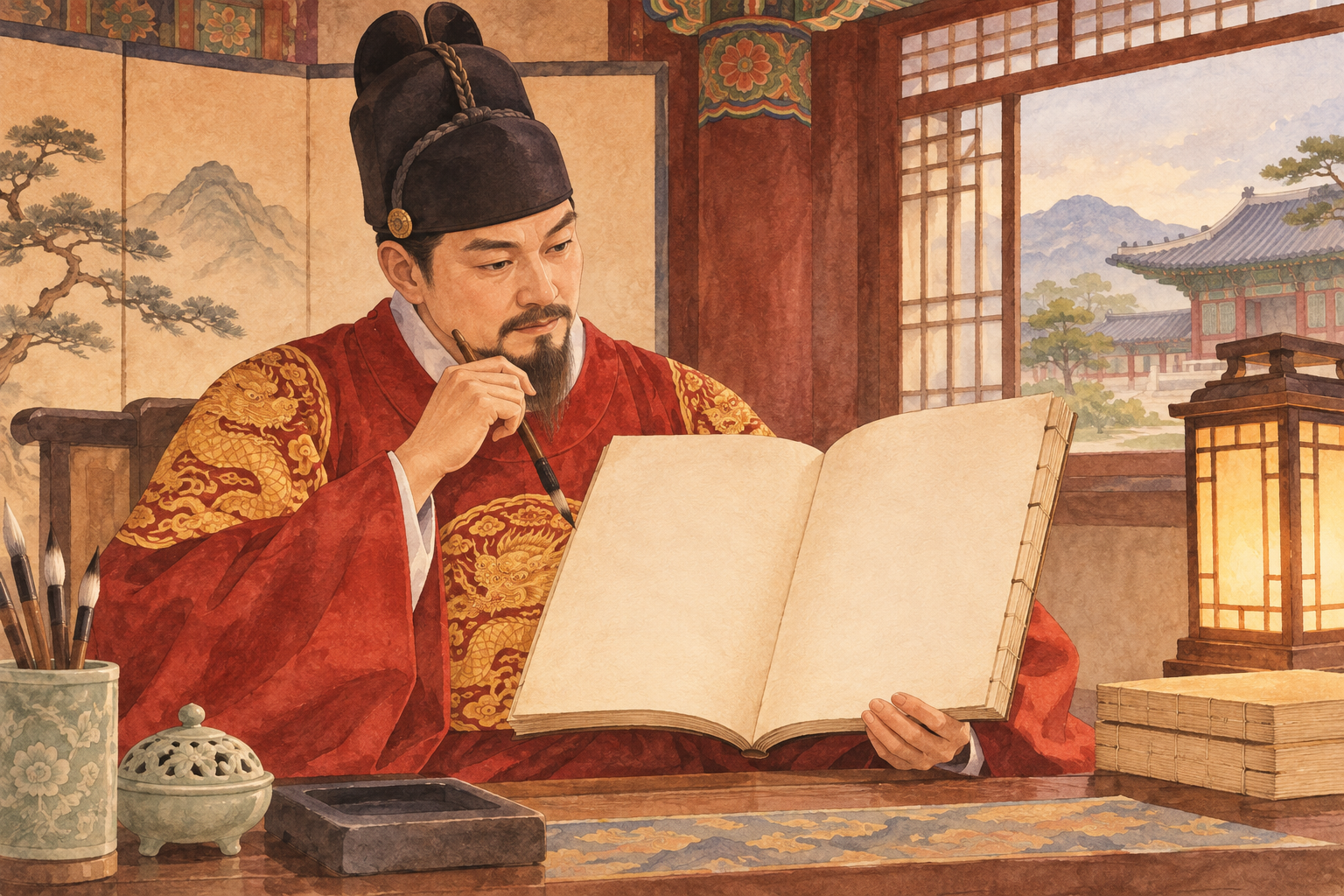
King Sejong ruled Joseon in the fifteenth century. In the preface to Hunminjeongeum, he explains that the speech of his people differed from Chinese and that many people struggled to express themselves in writing. His answer was a set of letters people could learn and use more readily. Think of an everyday message: if you can write down a name or a request yourself, you have another way to be heard. A new alphabet made that possible for more readers and writers, though its spread took time.
Two dates, and one name with two meanings
Sejong completed the alphabet in 1443. In 1446 it was publicly introduced with a book that explained its purpose and use. Hunminjeongeum can mean the original alphabet or the book that describes it. The name is often translated as ‘the proper sounds for instructing the people.’ The edition with detailed explanations and examples is known as the Haerye edition. UNESCO added the manuscript to its Memory of the World Register in 1997.
The shapes give you clues
Some basic consonants reflect how speech is made. Think of ㅁ as an outline of the mouth: when you make an m sound, your lips close. The original vowel design started with three shapes representing heaven, earth and the human figure: a dot, a horizontal line and a vertical line. The original system had 28 letters. Modern Hangul has 24 basic letters, with additional forms made by doubling or combining letters. The change in the count is a reminder that writing systems evolve as people use them.
Try building a syllable yourself
Start with ㄱ and add ㅏ to its right. Together they make 가. Now tuck ㄴ underneath to make 간. That bottom consonant is called 받침 (batchim). With a horizontal vowel, the layout changes: put ㅗ below ㄱ and you get 고. The basic idea stays the same: group the letters for one syllable into one block. Now return to 한글. The first block is ㅎ + ㅏ + ㄴ, and the second is ㄱ + ㅡ + ㄹ.
A script that took centuries to become everyday
The announcement in 1446 was the beginning of a long history. For centuries Hangul circulated alongside older writing traditions. It appeared in texts for readers beyond the scholarly elite and in personal writing, including letters. In 1894 it gained official status in Korea’s national writing system. Today it is the script you see on subway signs, in text messages and on menus. Start with a single block you can recognize, such as 가, and look for it the next time you see Korean text. You are already reading a little.
Check the official source
National Hangeul Museum — the history of Hangeul ↗
Independent educational information. Details and circumstances can change. Verify important information using the linked sources. See About for our editorial approach and important limitations.
Keep reading
How to Prepare for TOPIK: Levels, Study Time, and a First Practice Plan